
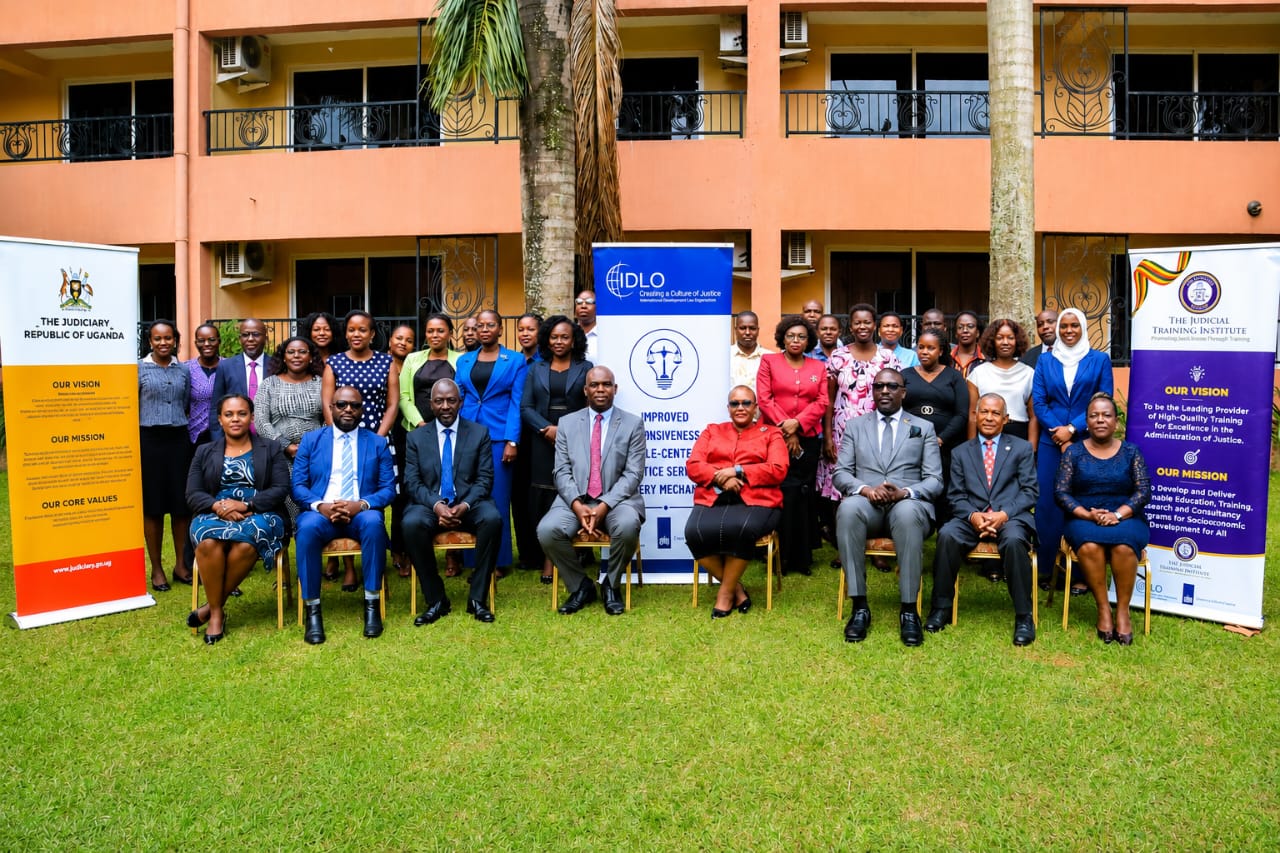
The Judicial Training Institute (JTI), in partnership with the Ministry of Gender, Labour and Social Development (MGLSD), the Industrial Court and the International Development Law Organization (IDLO), has launched a four-day regional training programme to strengthen labour justice and improving workplace dispute resolution across Uganda.
The training, which brings together labour officers from the Central Region, seeks to enhance their capacity in conciliation, mediation, arbitration, labour inspection, case management and the application of labour laws. It is the first in a series of regional trainings expected to cover the entire country.
Speaking at the opening ceremony, Supreme Court Justice and Chairperson of the JTI Governing Council, Justice Mike Chibita, described the programme as a major step toward strengthening Uganda's labour justice system through consistent and professional handling of workplace disputes.
Justice Chibita said labour officers play a critical role as the first point of contact in resolving labour disputes, noting that strengthening their capacity would reduce unnecessary referrals to the Industrial Court and improve access to justice.
He observed that these officers handle an average of 10 cases daily while the Industrial Court continues to grapple with a significant backlog, underscoring the need for effective first-instance dispute resolution.
"The expectation is that Labour Officers will apply the knowledge gained here to resolve disputes fairly, efficiently and consistently, while maintaining the highest standards of integrity and professionalism," Justice Chibita said.
The training covers labour law, jurisdiction, case management, hearing procedures, alternative dispute resolution, implementation of the Employment (Amendment) Act, 2026, and emerging labour issues such as the gig economy, migrant labour and child labour.

JTI Executive Director Justice Prof. Andrew Khaukha said labour justice is central to Uganda's socio-economic development, noting that productive labour relations contribute to national growth and social stability.
He said Uganda's expanding workforce is likely to generate more workplace disputes, making continuous professional development for labour officers essential to improving the quality of labour dispute resolution and easing the burden on the Industrial Court.
Justice Khaukha also called for greater investment in labour justice institutions, including mediation services under the Judiciary's Alternative Dispute Resolution framework, to facilitate faster and less adversarial resolution of labour disputes.
Representing the Commissioner for Labour, Industrial Relations and Productivity, Legal Officer Vanessa Bitature said labour officers are the cornerstone of Uganda's labour administration system because they enforce labour laws, promote compliance and protect the rights of both employers and employees.
She noted that the newly enacted Employment (Amendment) Act, 2026 introduces significant reforms requiring Labour Officers to strengthen their understanding of the law to ensure accurate interpretation and fair resolution of disputes.
Bitature acknowledged challenges facing labour offices, including staffing shortages, limited resources and manual case management systems, but revealed that the ministry is preparing to roll out an Access to Labour Justice Programme to improve technology, infrastructure and enforcement of Labour Officers' decisions.
Delivering the keynote address, Industrial Court Head Justice Linda Lillian Tumusiime Mugisha described labour officers as the backbone of Uganda's labour justice system, saying their effectiveness directly influences the court's workload.
She revealed that since becoming operational in 2014, the Industrial Court has registered 8,071 cases and currently has a backlog of 2,060 matters, most of which originated from labour officers across the country.
Justice Tumusiime Mugisha said strengthening labour officers' practical skills would improve consistency in handling labour complaints, reduce unnecessary referrals and enhance access to timely and effective labour justice.
IDLO Programme Manager Samson Assimwe reaffirmed the organisation's commitment to supporting institutional capacity building and promoting people-centred justice.
He said the initiative forms part of a broader programme that will also include public awareness campaigns on labour rights and support for mediation of labour disputes.
According to the organisers, participants will undergo practical sessions on complaint handling, case management, labour relations, ethics, emerging workplace issues and implementation of the Employment (Amendment) Act, with facilitators drawn from the Industrial Court, the Ministry of Gender, Labour and Social Development and experienced labour law practitioners.
